

Directional drilling has changed the way underground utilities are installed and upgraded in built-up and environmentally sensitive areas. Rather than relying on extensive open-cut trenching, this method allows pipes, conduits and cables to be placed along a controlled underground path with far less disruption at the surface. At Daley Directional Drilling, the process is supported by careful planning, specialised drilling equipment and accurate tracking methods that help guide installations beneath roads, rivers, buildings and other obstacles while protecting existing assets and maintaining service continuity.
This article explains how directional drilling is used to install water, sewer, gas, power and communications infrastructure below ground. It outlines the process from initial survey and bore path design through pilot drilling, hole enlargement and final product installation. By the end, readers will have a clearer understanding of how directional drilling works, where it is commonly used and what factors influence a safe and efficient installation.
Directional drilling is a trenchless method used to install underground utilities such as water lines, gas mains, power conduits and communications cables without digging open trenches across the surface. Instead of cutting a long excavation through roads, driveways or landscaped areas, the drill follows a guided path beneath the ground and then pulls the new utility pipe or conduit into place through the drilled hole.
The process is carefully planned and controlled from the surface using specialised drilling equipment and real-time guidance systems. When carried out correctly, it minimises surface disruption, shortens project timelines and reduces reinstatement costs compared with traditional open-cut excavation.
At its simplest, directional drilling involves three key stages. First, a pilot bore is drilled along a planned underground route. Next, the pilot hole is enlarged to the required diameter. Finally, the new pipe or conduit is pulled back through the hole to complete the installation.
The “directional” aspect comes from the ability to steer the drill head. A steerable drill bit with an angled face is guided along a curved or straight path using downhole locating technology. The operator can adjust depth, horizontal alignment and entry and exit points so the bore path avoids existing utilities, tree roots, foundations and other obstacles.
Because the work is controlled from the surface and the drill rods follow one another closely, the risk of widespread surface disturbance is greatly reduced compared with open trenching. This makes the method particularly suitable for urban streets, busy intersections and sensitive landscaped areas.
The process begins with planning and utility locating. Existing underground services are identified through records and on-site locating tools. A bore path is then designed with a specified entry angle, depth and exit point to maintain safe clearances around existing infrastructure and meet the requirements of the new service.
Once the setup is complete, the drill rig is positioned at the entry point. The pilot bore starts with a small-diameter drill head that cuts through the soil as drill rods are added behind it. A locating transmitter in or behind the drill head sends depth and alignment data to a surface receiver so adjustments can be made as the bore progresses. The operator alternates between forward drilling and steering adjustments to keep the pilot bore on the planned line.
After the pilot hole emerges at the exit point, the drill head is replaced with a reamer. The reamer is pulled back towards the rig, enlarging the bore to a size suitable for the product pipe. This step may be repeated with increasingly larger reamers for larger utilities or more difficult ground conditions. Drilling fluid is circulated throughout to transport cuttings, support the bore walls and lubricate the tools.
Directional drilling is used for underground utilities because it allows pipes and conduits to be installed along a planned path with minimal disturbance at the surface. Instead of digging an open trench from end to end, the drill enters at one point, travels underground, then exits at another, which makes it especially useful in built-up or environmentally sensitive areas.
This method is suitable for a wide range of utilities, including water, sewer, gas, power, communications and fibre. It also offers precise control over depth and alignment, which is critical when navigating congested underground corridors and protecting existing services.
Directional drilling in Sydney is widely used for water mains, sewer lines, gas lines, power conduits and telecommunications ducts. It is particularly effective for crossings under roads, rail lines, rivers and driveways where open cutting would be disruptive or impractical.
The method is also well suited to connecting new developments to existing mains within built-up streets. By working from small launch and reception pits near the verge or easement, utilities can often be installed while traffic and surface activities continue with minimal interruption.
One of the main reasons directional drilling is preferred is its limited impact on the surface. Only small entry and exit pits are needed instead of a continuous open trench. Streets can often remain open, properties stay accessible and landscaping may remain largely intact.
This is especially important in urban areas with busy roads, footpaths and driveways, or in established residential neighbourhoods where open-cut trenching would damage lawns, gardens, trees and hardscaping. Across highways, rail lines, rivers and waterways, directional drilling can often avoid the need for major traffic closures or large-scale temporary works, which helps reduce overall project disruption.
Directional drilling uses a guided drill head and real-time locating technology to steer the bore along a planned route. This allows new utilities to be installed at specific depths and offsets, which is essential in corridors that already contain water, gas, power and communications infrastructure.
Instead of cutting through the ground and exposing every existing service, the drill path can be designed to pass beneath or beside them. The operator continuously monitors the drill head’s depth and direction, then makes adjustments to maintain safe clearance around existing assets.
Directional drilling is effective for installations that would be impractical or highly disruptive using open-cut methods. Long crossings under roads, rail corridors, car parks, rivers and tidal areas can often be completed in a single continuous bore.
The method can be used across a range of ground conditions, from soft soils to mixed ground and some rock. With the correct drilling fluids and tooling, the bore can be stabilised and the risk of collapse or excessive settlement at the surface can be better controlled.
For larger diameter pipelines, a pilot bore is first drilled along the design path, then the hole is progressively enlarged before the product pipe is pulled into place. This staged approach allows installation over longer distances without the need for numerous access pits or open excavation.
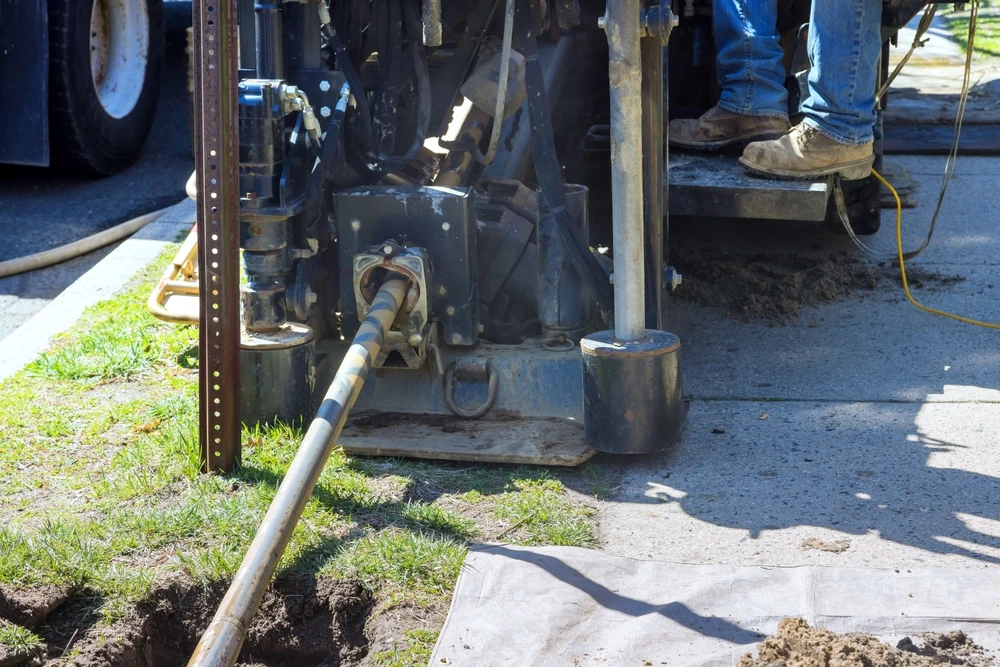
Directional drilling is widely used to install a range of essential underground utilities with minimal disruption to the surface. Instead of opening long trenches, utilities can be placed on precise alignments beneath roads, driveways, landscaping and sensitive environments.
Most buried services that need to cross obstacles or follow complex routes can be installed using this method, provided the correct pipe materials, drilling fluids and bore design are selected. The following utility types are among the most common.
Water and wastewater networks benefit significantly from trenchless installation. Directional drilling allows new water mains to be installed beneath roads, rail lines and waterways without shutting down traffic or access. Pipes are typically high-density polyethylene (HDPE) or PVC pressure pipes joined into continuous strings and pulled back through the drilled bore. This reduces the number of joints that could leak and can improve long-term reliability.
Gravity sewer lines and force mains can also be installed using directional drilling when grades and alignment are carefully designed. In built-up neighbourhoods, sewer laterals can be replaced or upsized under gardens and driveways with only small access pits at each end. This approach is often chosen where open-cut excavation would risk damage to tree roots, foundations or other buried services.
Gas distribution networks are among the earliest and most frequent users of directional drilling. High-strength polyethylene or steel gas mains can be drilled under highways and intersections with minimal impact on surrounding businesses and residents. The exact depth and path are controlled to maintain safe separation from existing utilities while meeting regulatory cover requirements.
Directional drilling is also used for conduit systems that carry power and communication cables supporting electrical networks, street lighting and renewable energy connections. By installing multiple conduits in one bore, future capacity can be provided without repeated excavation.
Telecommunications providers rely heavily on directional drilling to expand fibre and data networks in developed corridors. Small-diameter conduits can be drilled along footpaths and road reserves with short entry and exit pits, leaving surface features largely untouched. This is ideal for fibre-to-the-premises rollouts where many individual service lines must be installed quickly through dense existing infrastructure.
Directional drilling also supports long-distance backbone fibre routes. Where the cable path intersects creeks, rail corridors or major roads, the drill can place protective ducts beneath the obstacle in a single continuous shot. Once the conduit is in place, high-value fibre optic cables are pulled through and protected from surface activities, providing a secure long-term communications route.
Ground conditions and site constraints have a direct impact on how a directional drilling project is planned, priced and carried out. Soil type, rock hardness, groundwater and existing buried services all influence what equipment is selected, how the bore path is designed and what risks must be managed to avoid delays or damage.
A clear understanding of what lies below the surface and around the work area allows a more accurate assessment of drillability, expected production rates and the likelihood of complications such as frac-out, drilling fluid loss or bore collapse. This assessment is fundamental before committing to a specific drilling method or alignment for new underground utilities.
The ease and accuracy of directional drilling depend heavily on the material being drilled. Soft cohesive clays typically provide good bore stability and predictable steering. Sandy or gravelly soils are more prone to fluid loss and voids, which can cause washouts and make it harder to keep the hole to design tolerances.
Dense tills, cobbles and boulders increase the risk of tool deflection or refusal. Solid rock requires specialised drill heads, mud motors and often slower advance rates, which can extend project durations. Rock strength and abrasiveness also affect tool wear and the number of tool changes needed.
A geotechnical investigation that includes test pits, boreholes or at minimum local ground information helps define expected penetration rates, suitable drilling fluids, and the most appropriate bit type and downhole tools. Without this data, production estimates and pricing can be highly uncertain.
Groundwater level and ground permeability influence both bore stability and the behaviour of drilling fluids. High water tables and permeable sands or gravels increase the chance that drilling fluid will escape into surrounding ground or rise to the surface as inadvertent returns.
To manage this risk, drilling fluid properties such as viscosity and gel strength are adjusted to support the bore walls and control fluid loss. In environmentally sensitive areas or near waterways, more conservative pressures, closer monitoring and stronger containment measures are essential to reduce the risk of fluid breakout.
Groundwater can also affect the choice of entry and exit angles. Shallower angles may be required to maintain sufficient cover above the bore while avoiding surface heave or settlement caused by changing groundwater conditions.
Conditions at the surface are just as important as what lies below. Available work area affects drill rig setup, pipe string layout and the choice of safe entry and exit points. Confined urban sites, streets with heavy traffic and narrow easements can all restrict rig positioning and may require shorter staged bores or alternative alignments.
Existing underground services are another critical factor. Accurate locating and mapping of gas, water, sewer, power and communications assets guide the bore path design so that minimum clearances can be maintained. In congested corridors, the bore path may need to curve vertically and horizontally to thread between existing infrastructure while still meeting grade or cover requirements for the new utility.
Effective utility installation with directional drilling begins long before a drill head enters the ground. Thorough planning reduces the risk of strikes on existing services, helps prevent project delays and protects crews, the public and surrounding property. Safety considerations need to be built into every stage, from route selection and design through site setup, drilling operations and reinstatement.
A methodical approach also helps ensure compliance with local regulations and standards while supporting the accuracy and lifespan of the installed utilities. Careful coordination between designers, locators, drill operators and inspectors is essential to avoid problems once work begins on site.
Planning starts with locating and verifying all existing underground services. This typically involves utility record searches, contacting the relevant dial-before-you-dig service and carrying out on-site locating with electromagnetic locators and ground-penetrating radar. Potholing or vacuum excavation is then used to visually confirm critical utilities, depths and clearances before the drill path is finalised.
The proposed bore path is designed to maintain safe separation from existing water, gas, power, communications and sewer infrastructure. Minimum clearances are set according to local codes, utility owner requirements and drilling tolerances. Planners also consider soil conditions, groundwater levels, potential obstructions such as rock or rubble, and nearby structures such as foundations or retaining walls.
Every directional drilling project requires a site-specific safety plan. This covers traffic management around entry and exit pits, exclusion zones for non-essential personnel, emergency response procedures and communication protocols between crew members. Surface hazards such as overhead power lines, unstable ground and nearby public pathways are identified and controlled before work begins.
Regulatory compliance includes securing road opening permits, environmental approvals and any permissions required from utility owners and local authorities. Pressure testing, isolation and lockout procedures are followed when working near high-risk assets such as gas pipelines or high-voltage power.
Tooling, drill rigs and support equipment should be inspected and maintained to manufacturer standards. Drill operators and locators also need to be trained and competent in the specific guidance systems and steering tools being used. Daily pre-start checks, toolbox talks and bore logs help reinforce safety and planning requirements throughout the job.
Drilling fluid planning is critical for both safety and environmental protection. The drilling fluid mix is selected to suit the ground conditions so bore stability can be maintained and the risk of inadvertent returns to the surface is reduced. Sensitive areas such as waterways, stormwater systems and basements also need to be identified and monitored closely during drilling.
Containment measures may include lined pits, bunded recycling tanks and spill response kits positioned near the work area. Any unexpected fluid escape should be managed immediately through pumping, containment and clean-up in line with environmental guidelines. Waste drilling fluid and cuttings must then be transported and disposed of at approved facilities to help prevent soil or water contamination.
Noise, vibration and dust controls should also be considered during planning, particularly for work near homes, schools or businesses. Careful scheduling, equipment selection and surface protection all help minimise disruption and support compliance with local nuisance requirements.
Directional drilling has changed the way underground utilities are installed by combining precision, planning and reduced surface disruption. From subsurface investigation and utility locating through pilot bore navigation, reaming and final product installation, each stage is designed to protect existing infrastructure and support the long-term performance of the asset being installed.
By reducing the need for open excavation and limiting disruption to roads, businesses, traffic and landscaping, directional drilling offers clear advantages over traditional trenching in urban corridors, residential areas and environmentally sensitive locations. When it is planned properly and carried out by experienced specialists, it provides a controlled and efficient method for delivering modern utility infrastructure.


